
Company overview
The client is a technology-driven financial services company that provides consumer lending, payments, and savings solutions, partnering with retailers, healthcare providers, and other consumer-facing businesses to offer credit cards, installment financing, and digital payment products that help customers make purchases and manage finances more flexibly.
As one of the leading providers of private-label and co-brand credit card programs in the United States, it serves many well-known retail brands, manages millions of customer accounts, and differentiates itself through digital capabilities, embedded finance solutions, and integrated payment experiences for merchants.
The challenge
Financial products require production-like data, multi-system coordination, and lifecycle validation that traditional test-data practices struggle to support. Testing complex financial scenarios revealed several critical bottlenecks:
- Complex scenario creation: It was incredibly difficult to assemble the right account and loan conditions consistently across different test environments.
- Time-dependent events: Validating long-running loan and servicing events was significantly delayed, as important outcomes often unfold naturally over weeks or months.
- Cross-system consistency: Ensuring related data remained completely synchronized across various integrated platforms proved highly challenging.
- Manual coordination limits: Testing teams heavily depended on manual scripts, internal tickets, and constant platform support, which severely restricted their ability to scale.
- Governance pressure: As testing volumes grew, maintaining strict auditability, security, and production-safe handling became a paramount concern.
The solution
To overcome these bottlenecks, a unified data architecture was implemented, fundamentally transforming the approach to financial testing. The core of this solution was a self-service Test Data Management Portal that seamlessly orchestrated data creation, lifecycle advancement, and execution-ready delivery.
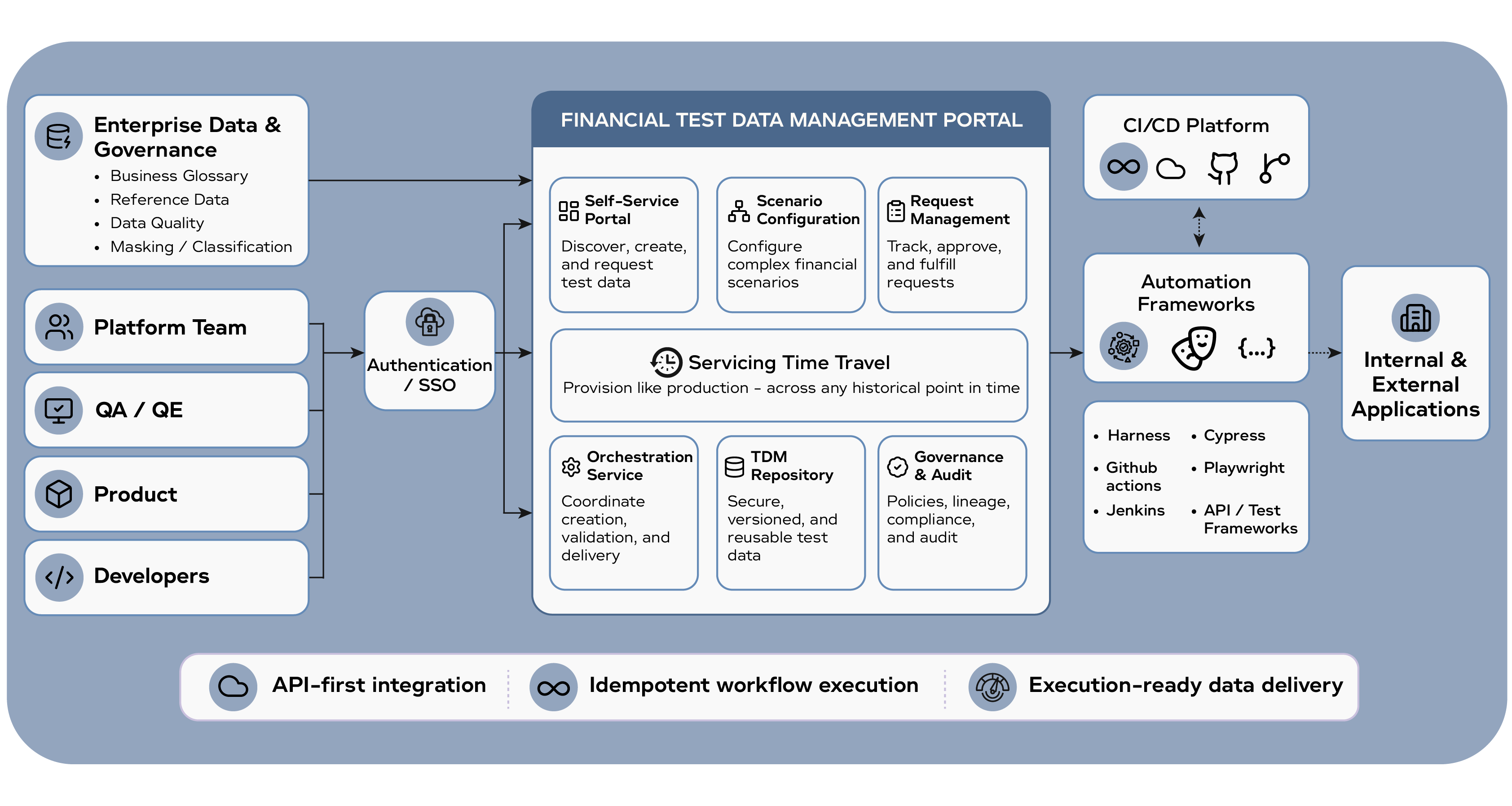
Key components of the solution included:
- Self-service provisioning: A guided portal allowed testers to discover, configure, and request complex financial conditions on demand.
- Servicing time travel: A built-in capability that deterministically generated and validated future loan states. Instead of waiting for real-world time to pass, teams could instantly advance loans through future servicing events.
- Cross-system orchestration: The platform coordinated data creation across dependent core loan servicing applications, collection systems, and payment services.
- End-to-end automation integration: Validated financial states were supplied directly to CI/CD workflows and automation frameworks for immediate execution.
- Robust governance: The system ensured safe data handling by enforcing approvals, access controls, data masking, and complete traceability.
The impact
The platform quickly matured from a targeted engineering utility into a highly scalable, enterprise-grade quality capability. This shift enabled repeatable financial testing at an unprecedented speed and volume.
Key metrics:
- Up to 90% faster data provisioning
- 13K+ test accounts provisioned
- 19x growth in request volume
Overall impact highlights:
- Massive operational scale: The portal sustained a 3.7x growth in monthly account throughput and successfully processed over 9,000 cumulative requests, supporting over 30 financial scenarios at peak adoption.
- Enterprise-scale repeatability: The standardized workflow ensured consistent execution across all functions and lines of business, bridging the gap between product creation and production readiness.
- Broader industry relevance: The architecture proved so successful that it evolved into a reusable model applicable across multiple regulated product domains, including Buy Now Pay Later (BNPL), Installment Lending, Credit Servicing, Merchant Finance, and Collections.
