
Software engineering has long rested on one assumption: humans do the work. People gather the requirements, design the system, write the code, run the tests, and approve the release.
Agentic AI is changing that.
Agentic AI goes well beyond autocomplete or a chatbot that helps engineers type faster. These agents can interpret context, generate specifications, design architectures, write code, run tests, fix defects, and operate workflows.
When AI moves from assistant to executor, technology leaders face a significant question: what happens to your engineering operating model when a machine can handle work that humans previously coordinated and performed?
The answer can’t be another productivity tool. It requires a new way of thinking, which we call the Agentic Development Lifecycle (ADLC).
Why ADLC, and why now?
Three forces are converging.
AI is moving from assistance to execution
The progression is clear: AI suggests, then generates, then executes, then orchestrates. The shift is not that AI writes code. It is that AI can run entire sequences of engineering tasks with minimal human involvement.
Software complexity keeps growing
Modern engineering spans multi-cloud setups, a web of APIs, distributed architectures, cybersecurity demands, and autonomous components. Adding more meetings, people, and approval layers won’t solve this. We need to coordinate human and machine intelligence at machine speed without losing human judgment.
Quality risk is moving upstream
If AI lets you build software much faster, but your quality assurance is still a bottleneck at the end of the line, you haven’t scaled productivity. You’ve scaled risk.
When execution accelerates, governance and assurance must accelerate with it.
ADLC: The six stages of an agentic engineering lifecycle
ADLC isn't just the old SDLC sprinkled with AI dust. It’s an AI-first operating model built around six interconnected stages where every phase produces more than just a static artifact. It generates context, decisions, and confidence for the next step.
Context ➔ Specification ➔ Design ➔ Implementation ➔ Assurance ➔ Learning
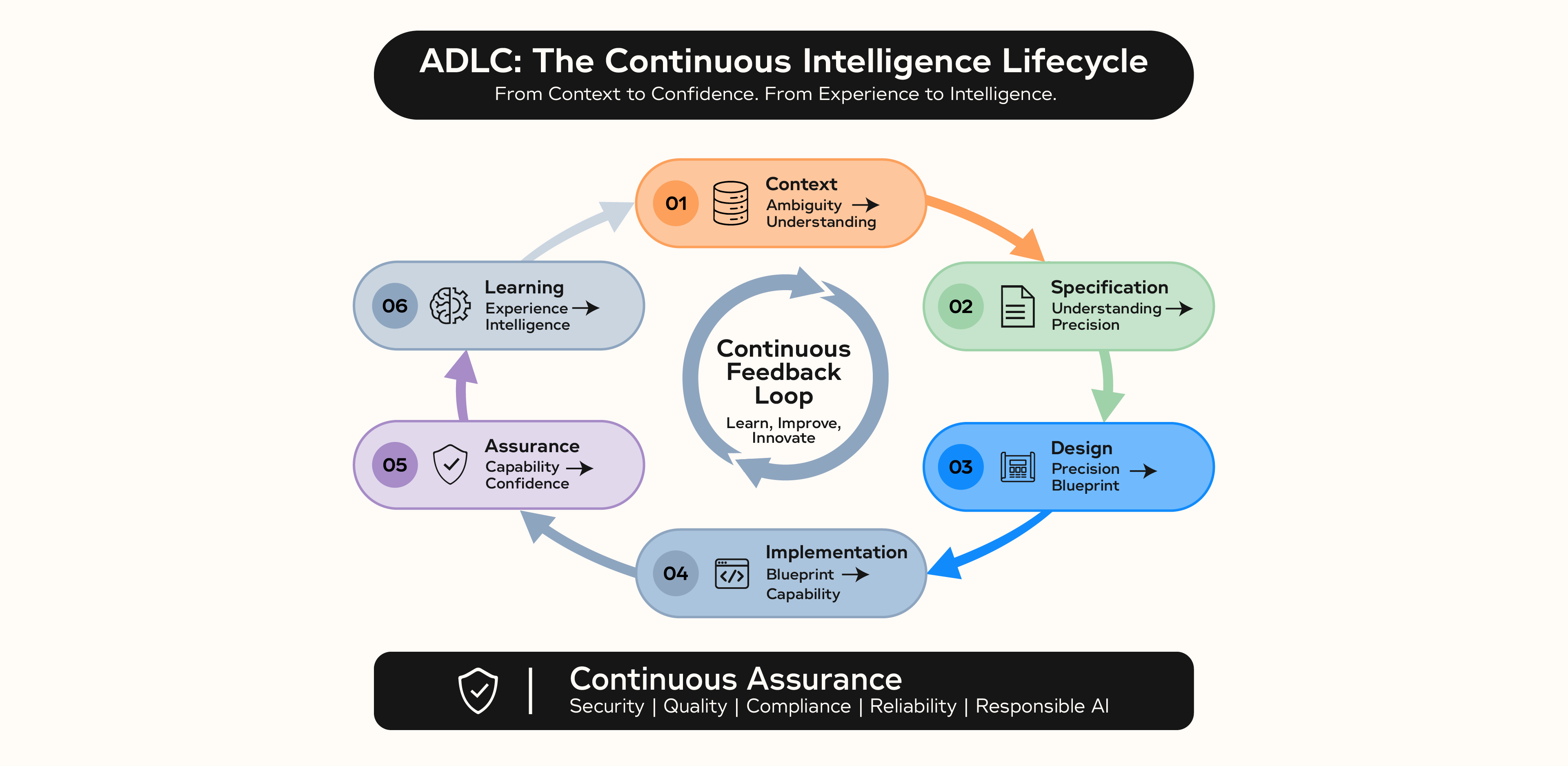
Context: What does AI need to understand?
Before asking an AI to build anything, you have to give it the right context: business goals, domain knowledge, enterprise policies, architecture, data, and regulatory constraints. Context engineering is becoming a core enterprise capability, because the quality of what AI builds reflects the context it is given.
The transformation: Ambiguity ➔ Understanding
Specification: What exactly should be built?
Speed means nothing if intent is unclear. Specification translates business context into precise, executable blueprints. Roles are shifting here. Business Analysts are evolving into Context Owners, and Product Owners are stepping up as Outcome Owners. The work doesn’t vanish; it evolves.
The transformation: Understanding ➔ Precision
Design: How should it be built?
Once the outcome is clear, AI agents can rapidly explore architecture patterns, data flows, security constraints, and cost implications. Humans remain in charge of consequential architectural and business trade-offs.
The transformation: Precision ➔ Blueprint
Implementation: How do we turn the blueprint into capability?
This is where AI’s contribution is most visible. AI agents generate code, spin up infrastructure, build configurations, and patch defects. Implementation is no longer just “AI writes code.” It’s AI executing engineering work within defined boundaries.
The transformation: Blueprint ➔ Working Capability
Assurance: Can we trust what was built?
In traditional SDLC, testing is a gate at the very end. In an agentic world, that gate becomes a bottleneck. If AI may be writing both the code and the tests, who watches the watchers? Assurance can’t be a final gate anymore. It must be an intelligent, living layer embedded across the entire lifecycle, validating security, behavior, and compliance continuously.
The transformation: Working Capability ➔ Confidence
Learning: What did production teach us?
Deployment isn’t the finish line; it’s the feedback loop. Telemetry, customer behavior, incidents, and performance data feed back into the start of the next cycle.
The transformation: Experience ➔ Intelligence
The biggest shift: Accountability moves
The most common misconception about agentic engineering is that more AI autonomy means humans check out. The opposite is true. As AI handles execution, human accountability changes location
- Humans increasingly own: intent, business outcomes, decision rights, ethical boundaries, risk appetite, and exceptions.
- AI increasingly performs: analysis, generation, execution, validation, and optimization.
The strategic question changes: We stop asking, "What work can we automate?" and start asking, "What decisions and actions can AI safely own and what must remain human-accountable?"
From teams to human-AI pods
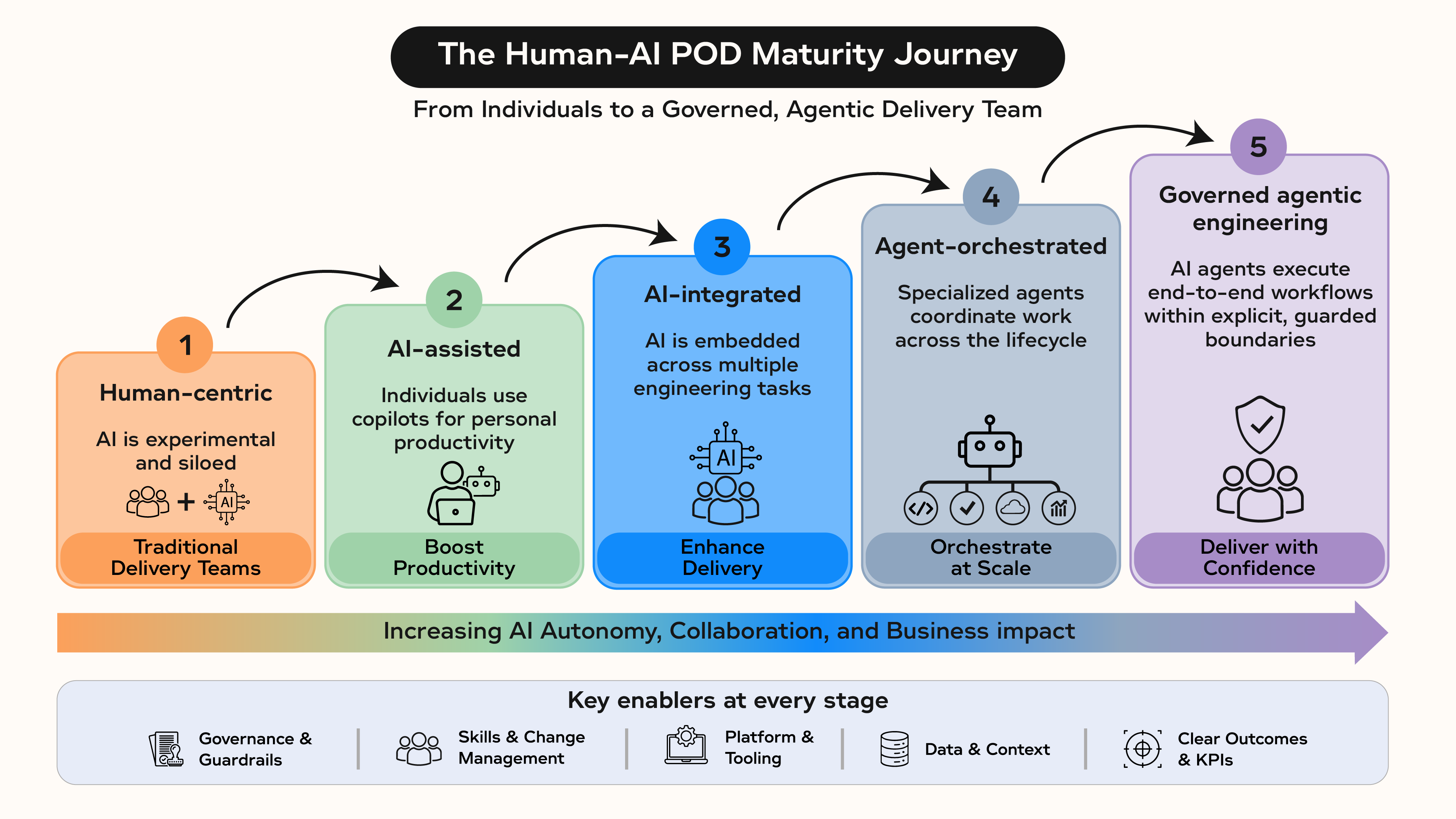
Traditional delivery teams are collections of human roles. The future belongs to the Human-AI POD, which blends human leadership (Outcome owners, Context owners, Governance leads) with specialized AI agents working alongside them as part of the team's core delivery capacity.
The rise of confidence engineering
Because quality can no longer be an after thought, an entirely new discipline is emerging: Confidence Engineering.
Confidence Engineering is the continuous practice of proving that AI-generated software, agents, and decisions can be trusted within strict business and risk boundaries. It asks hard questions at every single stage: Is the context trustworthy? Is the generated code safe? Are the agents behaving? Can we trust this release?
Five questions every CIO should ask today
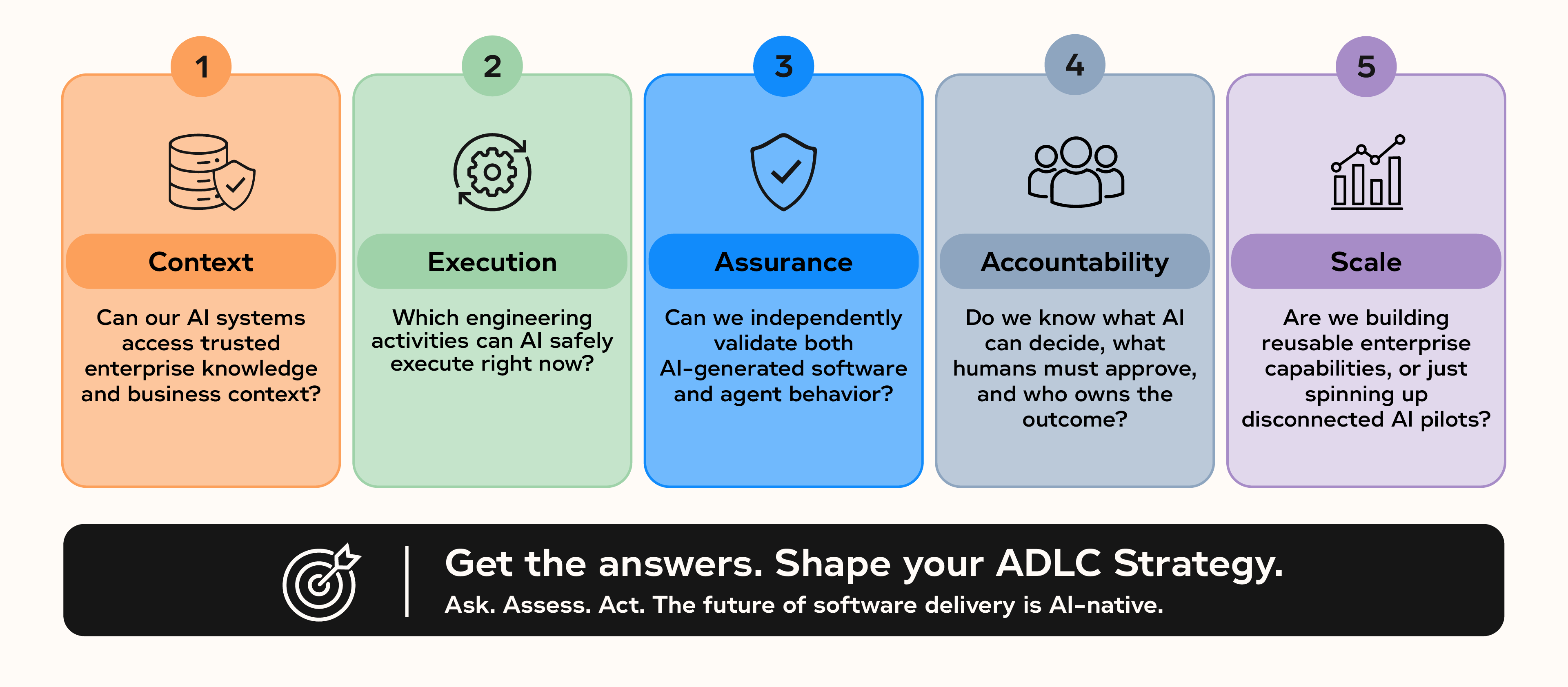
Before diving headfirst into agentic engineering, leadership needs clear answers to these five questions:
The next engineering advantage
ADLC isn't about making your old SDLC run a little faster. It’s about completely redefining what software engineering is.
The winning organizations won't necessarily be the ones that automate the most. They will be the ones that scale AI execution without scaling uncertainty.
The future of engineering isn't human versus AI. It combines human judgment, AI execution, and engineered confidence.