
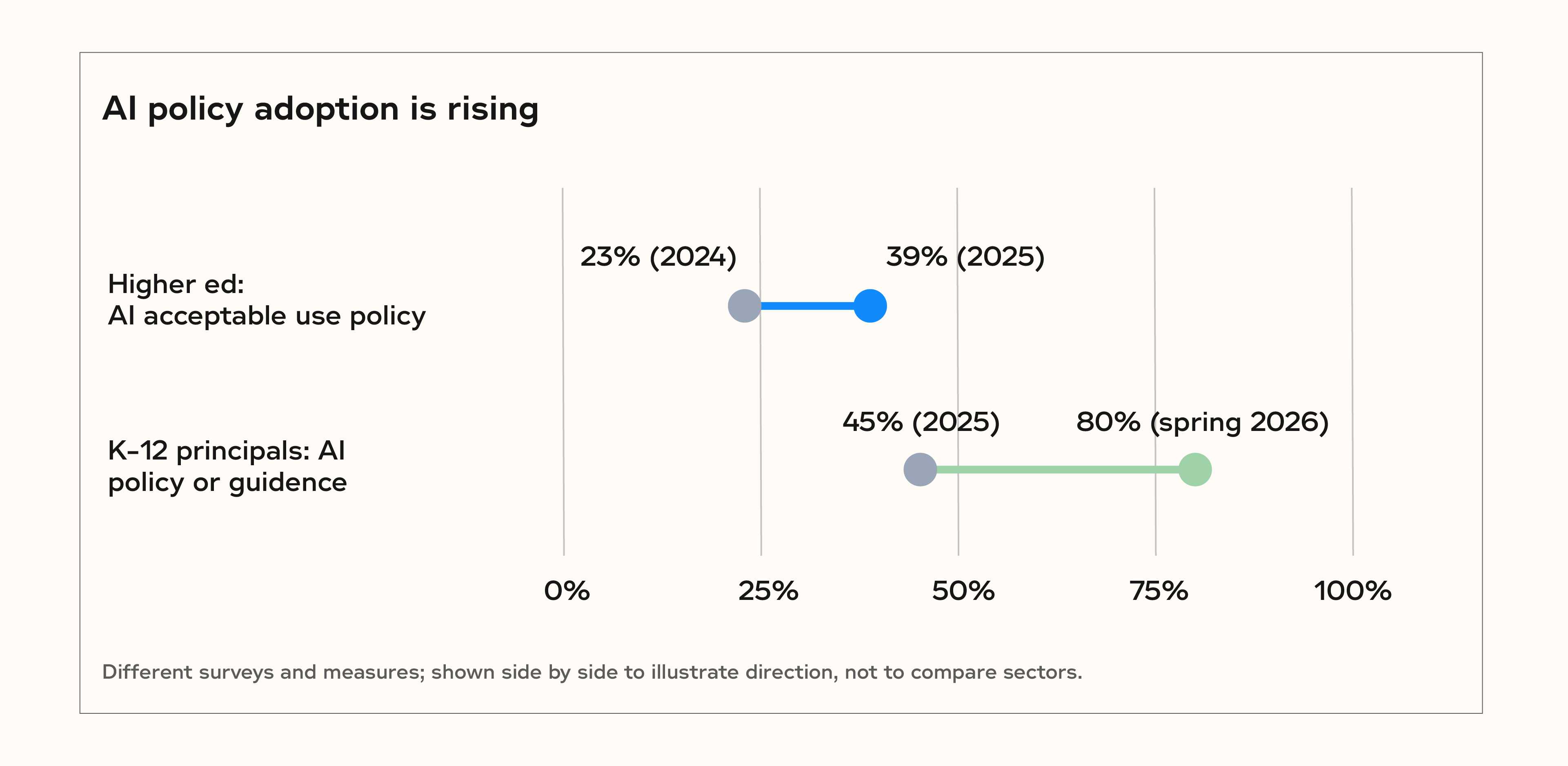
Ask a university where it stands on AI and it will likely point to a policy. That’s a fair answer. In the 2025 EDUCAUSE AI Landscape Study, respondents reporting AI-related acceptable-use policies rose from 23% to 39% in a year, and K-12 adoption has climbed sharply too (GovTech; EDUCAUSE).
It’s just not the question that matters.
Ask instead what evidence shows that campus tools follow the policy, and the answers thin out. Verification and Validation (V&V) closes that gap: it is the evidence that a system meets its requirements and serves its intended use. This blog sets out a risk-based V&V framework for higher education technology leaders, aligned to the NIST AI Risk Management Framework (RMF), with a short note for K-12.
What this means for institutions:
- Policies are spreading quickly. The open question is how institutions confirm they’re being followed.
- Institutions and providers already share good questions (HECVAT) and contract terms (data privacy agreements). Shared, testable evidence is the next step, and both sides benefit.
- A V&V framework aligned to the voluntary NIST AI RMF 1.0, with testing depth scaled to risk, turns policy statements into requirements that can be tested and evidenced.
This blog doesn’t intend to share any legal advice. Laws and frameworks are described as of September 2026.
Policy is spreading. Proof isn’t.
A policy states intent. Enforcement needs evidence of when practice drifts from it.
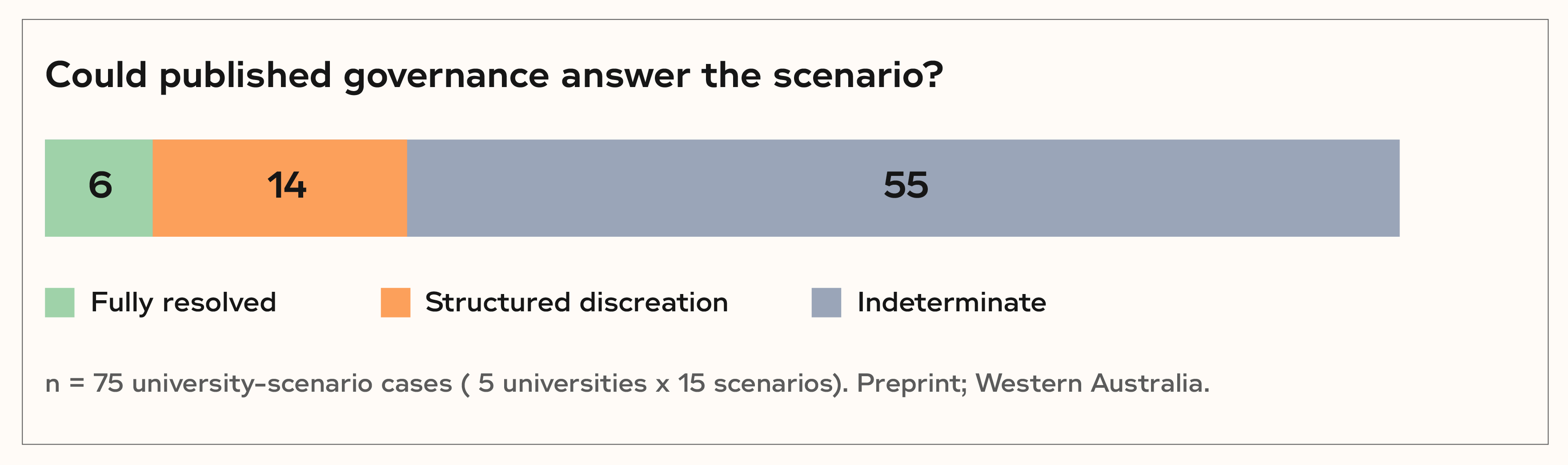
Yet policy may not resolve real decisions. A 2026 preprint tested five Western Australian universities’ published governance against 15 scenarios. Only 6 of 75 cases were fully resolved; authority was often named only generically, without decision criteria (Poudyal). The study is small and outside the US, but the gap is familiar.
Even strong frame works show it. UT Austin’s “AI-Responsible, AI-Forward” framework sets out eight teaching-and-learning principles, including agency and stewardship, and is reviewed annually. Operational controls sit in separate security guidance. What’s missing is evidence that a tool, in a particular course, behaves consistently with those principles.
That missing link is testability. “Use AI ethically” cannot be tested. “A human must confirm every grade before release” can.
The rules are narrow, and everyone asks for proof
The US has no broad higher-education AI governance mandate. Instead, narrower rules require institutions or providers to show specific outcomes:
Each rule depends on evidence: an accurate explanation, meaningful human review, data kept out of model training, or an interface that works with assistive technology. These are V&V questions.
Questionnaires are not enough
Institutions and providers already agree on many questions and contract terms. HECVAT shows how far that collaboration has come. Since2016 it has helped institutions assess providers against policy and risk appetite, and HECVAT 4 (February 2025) added community-developed AI questions and lets providers complete one annual assessment for multiple institutions (EDUCAUSE Review). The missing step is evidence that the important answers hold in each institution’s own deployment.
Neither side can close the gap alone. Interviews with 13 edtech leaders at seven institutions found that staff struggle to hold providers accountable because they lack visibility into provider systems (Kelso et al.). Providers, in turn, cannot see every customer’s configuration and use. Conformance, and its evidence, must come from both sides.
Reusable evidence can also shorten procurement and prepare providers for emerging documentation duties, including Colorado’s.
What a NIST-aligned V&V framework looks like
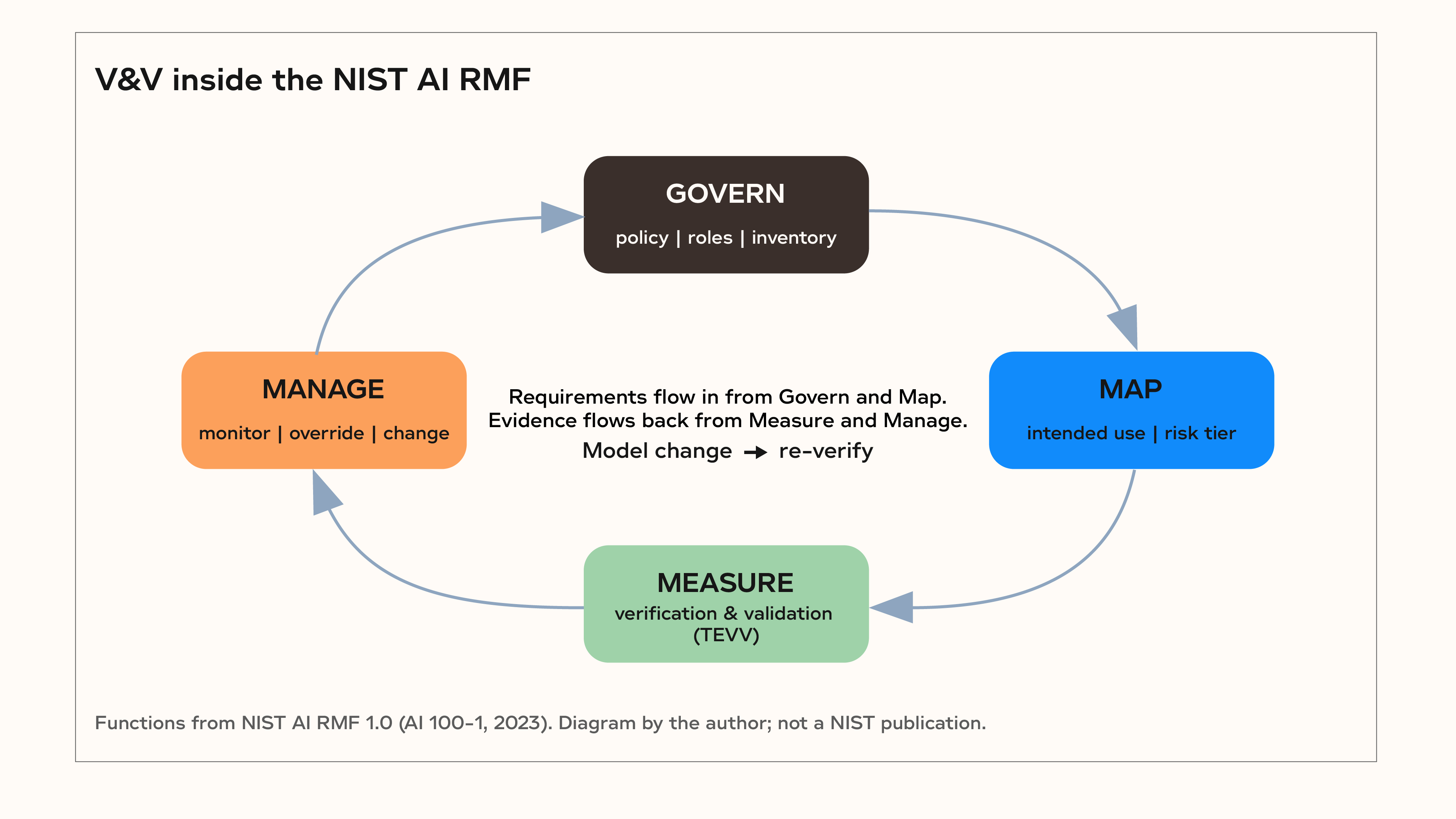
No new standard is needed. NIST AI RMF 1.0 expects testing, evaluation, verification and validation throughout the AI lifecycle, with documented results (NIST AI 100-1). Because the RMF is voluntary and has no certification, institutions should claim alignment, not compliance. NIST is revising the framework.
Verification asks whether a tool and its configuration meet institutional requirements. Validation asks whether it serves its intended educational use. These definitions are adapted from IEEE 1012-2024. In NIST terms, Govern and Map define policy, intended use and risk; Measure is where V&V happens; Manage determines when to repeat it.
Three ideas make this practical.
- Check both the product and the process. Product V&V tests whether the configured platform meets policy on data flows, fairness, explanations, accessibility and safe output. This is where AI assurance does its work. Process V&V tests whether people use the tool as required. “Faculty make the final decision” is a workflow requirement, not a software feature.
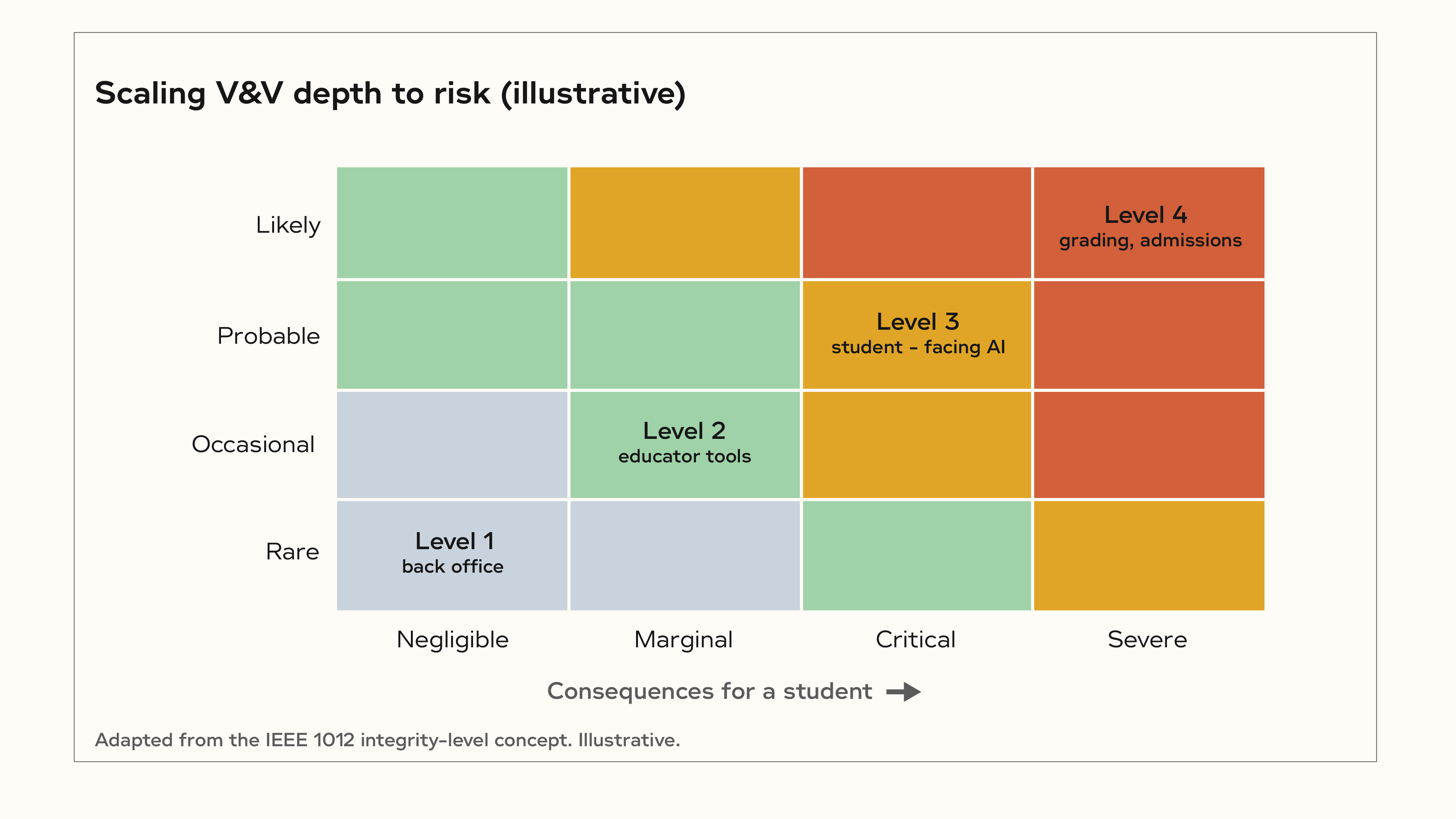
- Scale the depth to the risk. Scrutiny should rise with consequence and likelihood, and independence matters most at the top tier: NIST recommends that V&V be performed by people distinct from test and evaluation teams. A Level 4 tool, such as admissions scoring, financial aid, grading or discipline flags, warrants independent testing, fairness checks and proof that human override works. A Level 1 back-office tool may need only provider attestation and spot checks. Keeping low-risk reviews light supports adoption.
- Re-verify on change, not just on the calendar. Annual review is not enough when models change between cycles. Provider release notes should trigger re-verification, making updates a routine shared workflow.
From policy clause to evidence
Convert each policy statement into a requirement, a pass condition and an evidence artifact. The table below uses published policies and laws.
Take a hypothetical Level 4 admissions-prioritization tool. Under an “agency” principle, every application must reach a human reader, and reviewers must be able to override scores. Tests sample low-ranked applications to confirm human review, then try to finalize a decision without a reviewer and confirm the system blocks it. The evidence is a test report and override log, both rerun after a model update. For the “stewardship” principle, the equivalent test is a data-flow check, and data assurance is what confirms that student data doesn’t reach model training or undisclosed third parties.
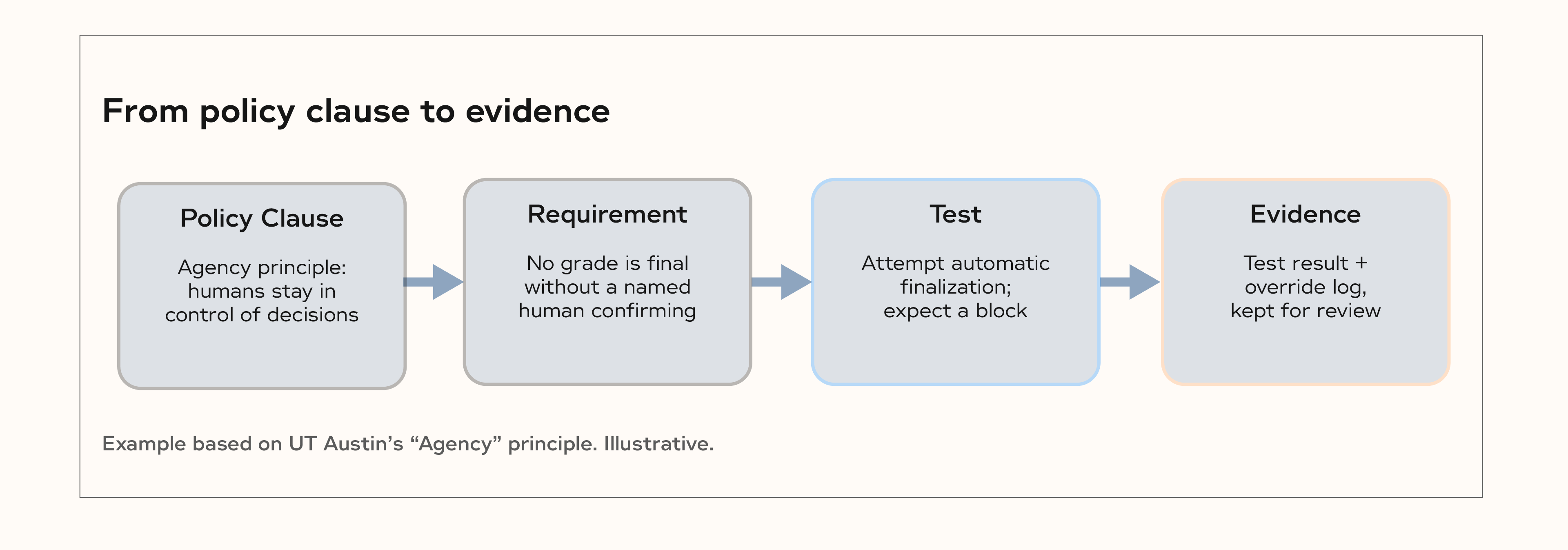
Structured this way, a policy clause or HECVAT answer becomes reusable evidence for both institution and provider.
Start with the inventory, not another policy
Five steps get an institution moving:
- Inventory AI in use, including features added to the LMS, CRM and student information system.
- Assign each tool a risk tier.
- Turn high-tier policy clauses into testable requirements.
- Agree evidence terms with providers, including model-change notice and test access.
- Run baseline V&V on selected high-risk tools and repeat it after changes.
Few institutions have the capacity to build this alone, which is where advisory and consulting support can shorten the path from policy to first baseline.
A note for K-12
K-12 faces the same evidence gap with less capacity and younger users. RAND reports that 80% of principals said in spring 2026 that their school or district had AI policy or guidance, up from45% in 2025. Yet interviewed teachers often said they had no policy or found it confusing.
Requirements are also becoming more specific. Maryland, Oklahoma, Idaho and Virginia require district AI policies; Maryland requires an AI coordinator, and Oklahoma bars AI from primary use in grading, discipline and other high-stakes decisions. Each requirement can be tested. Because most districts cannot run deep V&V alone, state rubrics, consortium testing and reusable evidence matter even more.
Conclusion
Higher education has written strong AI principles. What is missing is a mechanism to demonstrate them. Risk-scaled V&V aligned to the NIST AI RMF provides it, and because institutions and providers already share questions and contract terms, shared evidence is the natural next step.
Begin with one high-risk campus AI system and ask: what evidence shows that it follows our policy today?